Coffee Wood vs Olive Wood Dog Chews: What Actually Differs for a Buyer
Olive wood vs coffee wood dog chews: the olive oil, published hardness data, EU import route, EUDR scope and where each one wins.
By WINVN · · 6 min read
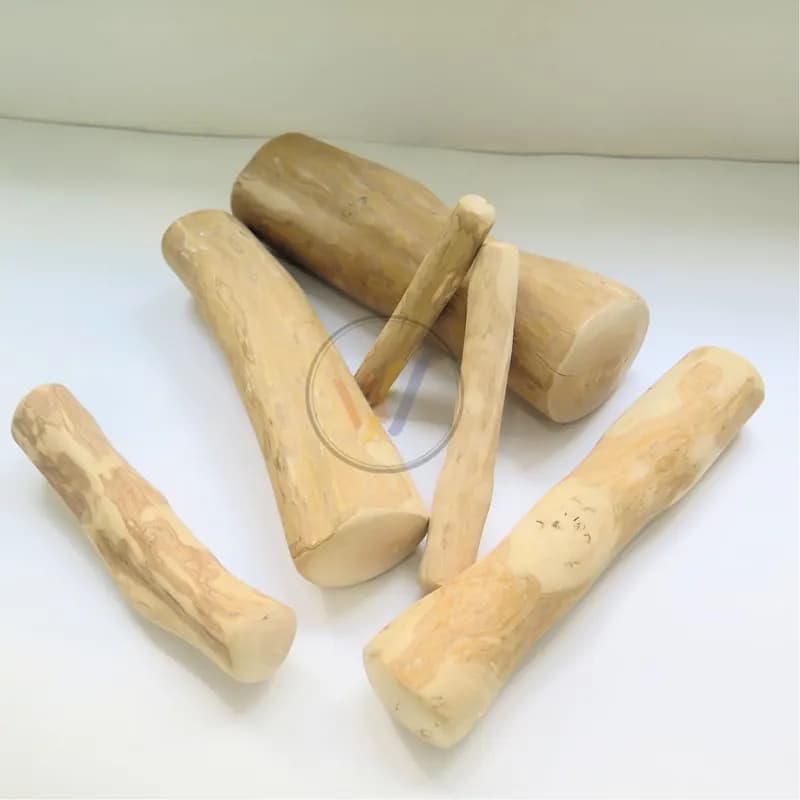
Olive wood and coffee wood chews sit next to each other on the same shelf and are described in almost the same words. The differences that matter to a buyer are not the ones on the packaging. This comparison is written by a coffee wood manufacturer, and olive wood wins several rows outright.
Short answer: most olive wood chews are dipped or infused with olive oil, while WINVN's coffee wood is one untreated material. Olive wood has published hardness and density data; coffee wood does not. For an EU buyer, olive wood from Italy, Spain or Greece moves inside the single market with no customs entry, which no Vietnamese supplier can match. Coffee wood's case is a factory that publishes moisture readings, carton counts, container loads and lead times.
What each one is
- Olive wood chews are usually cut from prunings. Olive groves are pruned regularly and the branches are a by-product. Some suppliers use aged, fruitless trees taken out of production instead.
- Coffee wood chews from WINVN are cut from the trunks and thick branches of Robusta coffee trees over 20 years old, removed at the end of their productive life during replanting in Dak Lak and Gia Lai.
The difference most buyers miss: the oil
UK customs has a published ruling on this product category. HMRC Advance Tariff Ruling 600010484 describes olive wood dog chews as olive branches sanded to remove sharp edges and then dipped in olive oil, and classifies them under commodity code 4421 99 99 99, other articles of wood. Several olive wood brands state the oil on the pack.
So the honest comparison is wood plus a food oil against one plant material with nothing added. Neither is wrong. But if your label says "single ingredient", or a retail buyer asks an allergen question, you need to know which one you are selling.
Hardness and density: olive wood has the numbers
| Figure | Olive wood | Coffee wood |
|---|---|---|
| Dried density | about 980 kg/m³ (Wood Database, Olea europaea) | no comparable published figure |
| Janka hardness | about 2,710 lbf | none published |
| Listed in standard timber references | yes | no |
Coffee is an agricultural crop, not a commercial timber species, so its wood has never been through the testing that puts a species into a timber reference. WINVN does not publish a hardness figure for coffee wood. If a supplier quotes one, ask which species, which standard and which laboratory. If you need a documented material specification for a technical file, olive wood is easier to support, and that is a real reason to choose it.
How each one wears
No study compares the fracture behaviour of these two woods. Every statement on either side is an observation. What WINVN can say about coffee wood: in normal chewing the surface wears into soft frayed fibres rather than breaking into hard fragments, which is an observation, not a guarantee. At least one independent trainer has published an account of a coffee wood stick splintering into sharp pieces, and we would rather mention that than leave it out.
Suppliers on both sides overstate. Olive wood listings carry "splinter-free"; some coffee wood brands say "non-splintering". Neither category has published a test to support it. The wording the evidence supports is a supervision instruction: match the size to the dog, supervise chewing, remove the piece once it is small enough to swallow.
The import route into the EU
| To an EU warehouse | Olive wood from Italy, Spain or Greece | Coffee wood from Vietnam |
|---|---|---|
| Customs entry | none, intra-EU movement | third-country import |
| Certificate of origin | not needed | EUR.1 under the EU–Vietnam agreement |
| Phytosanitary and fumigation papers | not needed | supplied per shipment |
| Transit | days by road | 30–35 days by sea from Cat Lai |
| Sensible order size | small and frequent | container or consolidated |
For an EU buyer who wants the shortest supply chain and small reorders, EU-grown olive wood wins, and nothing a Vietnamese supplier does closes that gap. Olive wood from Tunisia or Turkey is a third-country import like Vietnam, so most of that advantage disappears.
EUDR applies to both
You may hear that olive wood escapes the EU Deforestation Regulation because olive is not one of the regulation's named commodities. That conclusion is wrong. The wood scope of Annex I of Regulation (EU) 2023/1115 is defined by customs heading, and it includes heading 4421, where both products are usually classified. From 30 December 2026 (30 June 2027 for micro and small operators), the operator placing either product on the EU market files the due diligence statement. See EUDR for coffee wood dog chews.
Where each one wins
Olive wood wins on: intra-EU logistics, working capital, published material data, brand recognition with European shoppers, and very small first orders from workshop suppliers.
Coffee wood wins on: one material with nothing added; a factory that publishes its numbers (100,000 pieces a month, moisture below 14% on every batch, 429 cartons per 20 ft container, 60–80 day lead time for custom packaging); a documented export file; and private label from 50 pieces with laser engraving at $0.10 per piece.
Claims neither side can support
- "Does not splinter."
- "Fully digestible."
- "No trees are cut down." Both come from ongoing agricultural work.
- Any dental, health or disease claim. Article 13 of Regulation (EC) No 767/2009 prohibits disease claims on feed outright.
Questions buyers ask
Is olive wood harder than coffee wood?
Olive wood has a published Janka hardness of about 2,710 lbf. No Janka value has been published for coffee wood, so no honest comparison can be made.
Is olive wood treated with anything?
Most olive wood chews are dipped or infused with olive oil, as described in HMRC Advance Tariff Ruling 600010484. WINVN's coffee wood has no oil, glue, coating or preservative.
Which is easier to import into the EU?
Olive wood from inside the EU, because it needs no customs entry. Coffee wood from Vietnam needs a customs entry, an origin certificate and plant-health paperwork.
Request three free coffee wood samples and compare them with the olive wood you already stock.